How We Make Our Handmade Wildlife Nest Boxes
Scott MartensShare

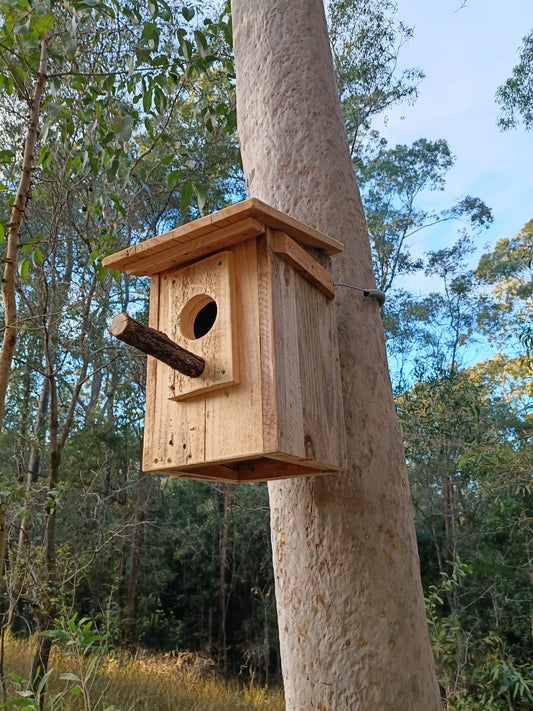
Every Potting Mad Wildlife Nest Box is individually handcrafted in Queensland using reclaimed pallet timber.
Rather than mass-producing one generic design, we build each box to suit the bird or mammal selected by the customer. The entrance size, internal features and whether an external perch or landing support is appropriate are all considered during construction.
Here is a closer look at how our handmade wildlife nest boxes are created.
🌿 Starting with Reclaimed Timber
Each nest box begins with reclaimed pallet timber that has already had a previous working life.
We inspect the available boards and select suitable sections for the walls, roof, floor and internal components. Damaged or unsuitable areas are removed, while as much usable timber as possible is retained.
Because the timber is reclaimed, every board has its own grain, knots, markings, weathering and natural colour variations.
These differences are not considered faults. They are part of what makes every finished nest box unique.
📏 Measuring and Cutting the Components
Once the timber has been selected, the individual nest-box components are measured and cut.
The front, rear, sides, roof and floor are prepared separately before being checked for fit. Reclaimed boards are rarely perfectly uniform, so small adjustments are often required during construction.
The edges are tidied and any unsuitable areas are removed while retaining the rustic character of the original timber.
🦜 Building for the Selected Species
Different Australian birds and mammals require different nest-box designs.
The species selected when ordering determines the entrance-hole size, internal features and whether an external perch or landing support is appropriate.
A nest box designed for a Rainbow Lorikeet will differ from one intended for a Crimson Rosella, Kookaburra or Brushtail Possum.
Rather than cutting the same entrance into every box, we customise the opening to better suit the intended occupant.
🕳️ Creating the Entrance
The entrance is measured and cut after the intended species has been confirmed.
Birds and mammals vary considerably in size, so the opening must be appropriate for the animal the box is designed to support.
A species-specific entrance also helps make the box more suitable than a generic design with an opening that may be too large or too small.
🪜 Adding the Internal Ladder
Our bird nest boxes include an internal timber ladder beneath the entrance.
This creates a textured climbing surface that can help young birds reach the opening when they are ready to leave the nest.
The ladder remains safely inside the box and is fitted as part of the internal construction.
🐦 Deciding Whether to Add a Perch
An external perch is not automatically fitted to every nest box.
Native hollow-nesting birds generally do not require a perch to enter their box. Adding one may also provide unwanted birds, including Common Mynas, with an easier place to wait near or investigate the entrance.
For this reason, our bird nest boxes are generally supplied without an external perch unless one is specifically requested or considered appropriate for the selected species.
Possum boxes and custom designs may include an external landing support where it is useful for the intended occupant.
🔨 Assembling the Nest Box
Once the main components have been prepared, the walls are positioned and securely assembled.
The structure is checked throughout construction to ensure the box remains stable and provides a deep, sheltered internal space.
A sloping roof is then fitted to help direct rainwater away from the box and provide additional weather protection.
🧹 Adding the Removable Floor
Each Potting Mad Wildlife Nest Box includes a removable floor panel.
This allows the interior to be accessed for cleaning, inspection or maintenance when required without dismantling the entire box.
Old nesting material may occasionally need to be removed after the occupants have left, and the removable floor makes this process easier.
A nest box should never be opened or cleaned while it is occupied. Always wait until you are certain the animals have left and breeding activity has finished.
🎨 Choosing the Finish
Our wildlife nest boxes are available in three exterior finishes.
🌿 Natural Timber
The raw timber option is left untreated to showcase the reclaimed wood's natural colour, grain and rustic character.
🛢️ Tung-Oiled Exterior
The exterior is finished with 100% pure tung oil to enhance the timber grain and provide additional weather protection.
🎨 Painted and Sealed Exterior
The exterior can be painted in green, brown, black or camouflage and then sealed with clear lacquer for added durability.
The interior remains suitable for the intended wildlife design while the exterior finish helps the box blend into its garden or bushland setting.
🔩 Preparing the Mounting System
A heavy-duty mounting system is added so the completed nest box can be securely installed on a suitable tree or post.
The fittings are checked before the box leaves our workshop, but the final installation method should always be appropriate for the mounting location and the size and weight of the box.
✅ Final Inspection
Before a nest box is ready for collection, we check:
- The overall structure and stability.
- The entrance size for the selected species.
- The internal ladder where required.
- The removable floor panel.
- The roof and exterior finish.
- The mounting system.
- Whether a perch or landing support has been requested or is appropriate.
Because every box is built individually from reclaimed timber, small differences in dimensions, grain and appearance are expected.
♻️ Why We Use Reclaimed Timber
Reclaimed timber gives existing material a useful second life instead of allowing it to go to waste.
It also gives each nest box its own individual character. Nail marks, knots, colour differences and weathered sections all reflect the timber's previous history.
The result is a functional wildlife habitat product that is genuinely handmade rather than factory-produced.
❤️ Handmade with Purpose
Every Potting Mad Wildlife Nest Box is cut, assembled, customised and finished by our family in Queensland.
Our goal is to create practical backyard habitat products while making thoughtful use of reclaimed materials.
Each completed box tells the story of the timber it came from and provides a potential new home for Australian wildlife.
🛒 View Our Handmade Wildlife Nest Boxes
Our wildlife nest boxes can be made for Rainbow Lorikeets, Crimson Rosellas, Kookaburras, Brushtail Possums and custom species.
View the Handmade Wildlife Nest Box
Reclaimed timber. Handmade in Queensland. Built for Australian wildlife. 🏡🌿